The ANU Order of Australia Oration, 2024
Yumulundi – yetu tung, hello!
Daora nuna daora Ngunnawal. Yangu gulanin nalawiri, dunai Ngunnawal daora. Wangaralijinin marini balan bugarabang.
This is Ngunnawal country. Today we are all meeting together on this Ngunnawal country. We acknowledge and pay respect to the elders.
Thank you, Mr Andrew Phelan, for inviting me to deliver this year’s Order of Australia oration. I would also like to thank the ANU for hosting this event.
Today, I feel immensely privileged. Coming from India, it has been a long journey to chart out a research field in gender and natural resource management. The most significant part of that journey began in Australia when I joined the world’s best colleagues at the Australian National University. Today, I say ‘Thank you’ to them for their collegiality, camaraderie, and love. A very special ‘thank you’ goes to my collaborators in ANU’s Gender Institute who made it possible for me to stand here today. I love you all! And to all of you, your presence here humbles me, and I am grateful that you are sharing your time with me.
At first glance, gender equality and a sustainable world for future generations might seem as incompatible as oil and water. Gender is a niche domain for feminists, while scientists deal with the environment, resources, and sustainability. I will show you that these two are deeply intertwined. A sustainable world is built on gender equality.
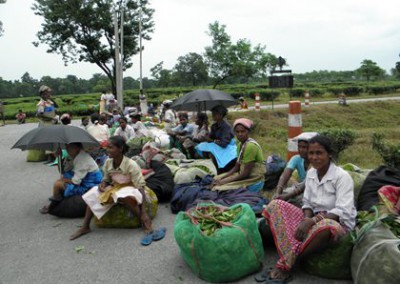
Let me start with the story of Mina, a woman living on a tiny island in a riverbed in India. Her husband has left for work in a nearby town, and she manages the household, the children, the livestock, and a small agricultural plot that no longer provides the family with subsistence as it did decades ago. Mina is one of the women who make up nearly 63% of workers in Indian agriculture, or 43% of women farmers globally.
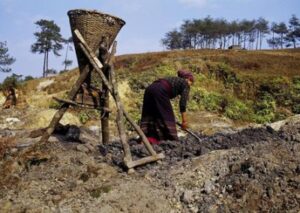
A few decades ago, her work on the family farm would have been limited to transplanting rice paddies and harvesting. Still, with increasing frequency, the multiple crises caused by unpredictable weather conditions, high input costs, and a lack of reasonable market prices have stifled the lives of smallholder farmers, pushing men out of farm work. The depth of the agrarian crisis can be discerned from, among other indicators, farmers’ suicides: nearly 300,000 farmers died this way between 1995 and 2014, but the pace has increased, as in the nine years between 2014 and 2022, over 100,000 farmers committed suicide. Mina was lucky that her husband migrated but did not commit suicide; in 2022, nearly 12,000 farmers and agricultural workers resorted to suicide in India. The result of this feminisation of agriculture is that Mina, and many women like her in other countries, are doing work for which they had no training, using assets they do not own, without being able to decide what to crop and where to sell or to control the incomes, and most importantly, without the ownership of the land they till.
With minor variations, this remains the case with small-holder farming around the majority world, where the oppressive structures of patriarchy have collaborated with policies that favour market expansion. Millions of women’s lives are determined by two concurrent and broad processes: first, the economic reform programs that favour capitalist market expansion and incorporate rural (and locally environment- and resource-dependent) communities into the global economy; and second, the rapid pace of environmental change, whose impacts are gender- and class-selective. Let us see what a feminist explanation could be for the lives of millions of women in less affluent countries.
Women’s struggles have borne fruit for women. Today, when we are supposed to be living in a post-feminist world where many people tend to believe that ‘the problem’ of gender inequality has been resolved, it is difficult even to think that it was only about 122 years ago that Australian women received their voting rights, to be treated as political citizens for the first time. When Australia passed its Equal Opportunity Act in 1977, allowing women the right to choose to work in any field, we can say women were recognised as economic citizens.
But women like Mina have been working all their lives, right? Their interests were then relegated to the field we know today as ‘development’, and women in more affluent nations became the torchbearers of what is known as the ‘rights-based’ approach for women like Mina. The problem was that we never got around to seeing women as resource-using citizens and to recasting their political rights, citizenship, and the rights to livelihood and development as parts of one whole.
Another reason why the embracing of sustainable development and ensuring the security of women’s livelihoods did not share the same platform is because of a Western, biologically essentialist idea of women being inherently closer to nature. Some feminist philosophers argued that the domination of nature and the subjugation of women are interconnected, arising from the same logic of dualism that structures Western thought. This idea was imperfectly superimposed on rural women like Mina, suggesting that she is doing what comes to her ‘naturally’. Interpreting women’s enormous work burdens in the majority world and their substantial economic contributions as their natural inclination is fundamentally problematic. The women you see here carrying their fuelwood home have always, always been financial as well as resource-consuming citizens.
Over the last four or five decades, feminist approaches to women and gender in development have evolved.
After the initial ‘count women in’ phase, the focus shifted to a more dynamic interpretation of gender relations in development initiatives. This approach considers the social relationship between women and men, assuming that women’s disadvantage arises because of differences between institutions that are numerically and, more importantly, culturally male-dominated. In this approach, for example, feminist analyses of environmental management would consider how and by whom ecological management practices and policies are established and whether tools and techniques used in management favour some groups over others. It would also focus on the rules and codes of social relations that shape resource management practices and lead to differential outcomes for women and men.
The challenge here is to remember that beyond gender, other dimensions of social life, such as race, ethnicity, class and caste, also play critical roles. The privileging of gender may invoke a paralysis and/or a simple unwillingness to engage with these dimensions as crucial factors in producing social inequality. Because liberal feminists generally dominated the field of development as experts from more affluent nations, this was not an easy task, leading to a lack of studies that used the concept of intersectionality. Conceptually, this approach can challenge gendered categories used by natural resource managers by highlighting that the weaker and more marginalised people have been left out. If one of the desirable outcomes of environmental management is social equity, then considering intersectional identities can yield better equity outcomes. The challenge is that policies are usually crafted to address a single social or environmental issue, and it is not always clear which intersections are most important to address.
Consequently, the policies and initiatives of sustainable development, particularly the ambitious Sustainable Development Goals—designed to integrate global consensus on tackling poverty, reducing inequality, combating climate change, and protecting ecosystems, including oceans, forests, and biodiversity—only aimed to bring gendered impacts and responses. Some sustainable development initiatives even continued to target women as a homogeneous and undifferentiated social category. Researchers failed to address the question of race explicitly, eliding an explicit engagement with race by subsuming it into the more palatable language of ‘difference’. Finally, what is missing in this detailed and universal attempt to ameliorate environmental degradation and its adverse livelihood effects on women was the question of social justice. I will come to that in a minute.
Let us look at the difference in ownership of one of the most critical assets – land. Throughout the world, women own considerably less land than men. In some African countries, the percentage of land owned by women is less than 10; globally, across all nations and contexts, women own just around 12% of land. Feminist research shows that this asset gap arises from individuals’ decisions in four areas, made either alone or as part of a group of decision-makers.
This slide presents a comprehensive way to put it: first, members of households and families; second, members of one or several communities; third, residents in a country; and fourth, people whose livelihoods are generated in the presence or absence of markets. The domains are not mutually exclusive; instead, they overlap and interact, affecting each other and the persons within. But broadly, this is how different factors influence access to land.
Moving away from the household as a decision-making unit and focusing instead on how gender identities of individuals within the household are constituted will not help us understand why rural societies and communities prioritise men’s or women’s access to land. Gendered access to land can provide insights into gender impacts of significant political-economic changes, such as the individualisation and commodification of rural land.
Considering all these allows us to extend the analysis of power beyond the ‘individual’ scale to include the household, thereby complicating understandings of how gender works in this private, microscopic domain. This way, we can treat gender as a critical variable in shaping resource access and control, interacting with class, caste, race, culture, and ethnicity, the processes of ecological change, and the prospects for sustainable development. This way, we not only revisit gender to invigorate debates in this area at a time when social theory offers profound challenges to conventional gender and environment approaches and invites a vigorous analysis of gender and gendered socio-natures across multiple sites and scales within the wider political economies of natural resource governance during the extraordinary conditions of the Anthropocene. I will explain these terms in my next slide.
We are now living in the Anthropocene, where things are no longer what they used to be. Environmental challenges characterise Anthropocene—in the form of changing climates, increasing numbers, frequency, and intensity of disasters, degradation and exhaustion of resources, and extreme distress of rural communities—that have reached the tipping point. Humans today are much more than just Homo faber, humans as makers, manipulating the natural world in the Anthropocene. They are Homo consumens, humanity the consumer, and, most importantly, Homo colossus, humans bent on destroying non-renewable resources.
One of the realities of the Anthropocene is that the environment is no longer separated from us, no longer ‘out there’ as something external, outside of humans, and only as a source of resources to extract. We, humans, have become a force of Nature, a dominant force shaping ecosystems and the climate, collapsing that separation. Consider, for a moment, the ways our societies have undermined the Earth’s biophysical integrity—deforestation, urban expansion, commercialisation of agriculture, rampant extraction of natural resources, and industrial development. These processes are reconfiguring the delicate balance of life-sustaining systems, such as water, rivers, land, and forests. And it is not just the planet that is changing; the societies we live in are also being reshaped differently by these ecological transformations. The world has never seen the level of inequalities between and within countries, never seen so much social injustice.
This intertwined relationship between humans and nature—what we call socio-nature—makes it imperative that we look at the sustainability of the world through a gender lens. The point is simple; if our social structures and ecosystems are co-produced and entangled, then there is a need to fully appreciate the gendered Anthropos, what she does, what her contributions to the economy and the society are, and the web of relationships and structures she lives in, and to put gender equality at the forefront of all our plans, policies and actions for a more sustainable future.
Social justice and gender are interconnected, as both address issues of equality, rights, and access to resources. First, social justice emphasises fair treatment for all individuals and advocates gender equality. To put it simply, this means addressing disparities in opportunities, rights, and resources between women and men from all classes, races, creeds, sexualities, and abilities, highlighting the extraordinary challenges faced by marginalised groups. Movements for social justice from feminist perspectives have pushed for policies and practices that promote women’s rights and gender equality, such as reproductive rights, equal pay, and protections against gender-based violence. Social justice seeks to ensure that all individuals have access to essential resources, including education, healthcare, and employment.
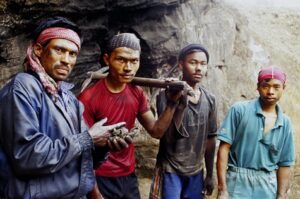
The justice landscape is saturated with power, especially given the urgent need to move away from coal. On this slide, you are looking at someone whom the Indian government sees as a criminal, because she is taking coal from within the leasehold area of a state-owned mine. Her village was displaced to make way for a large, open-cut coal mine. There are no more forests left for her to collect flowers, fruits, barks and roots from, so she now ‘collects coal’ from what used to be her family’s land. She makes a moral claim to the coal, despite harassment from the police and the company’s security guards.
In the Anthropocene, we know that we must move away from coal. To ensure that those whose livelihoods are coal-reliant, we now use the concept of ‘just transition’, which is essentially a derivative of concepts of universal rights and justice. But how can we ensure that kind of justice in a socially heterogeneous world? This woman’s life is now circumscribed by coal; there is no denying it. There is no forest left, the water table has gone down, and the coal dust covers the entire region. She is not alone; hundreds of thousands of women and men are involved in similar informal livelihoods. For just transition to occur, how do we see this evidence that represents a different kind of truth? How do we then aim to arrive at a deeper understanding of justice for those women and men living and working informally in the coal regions of the majority world?
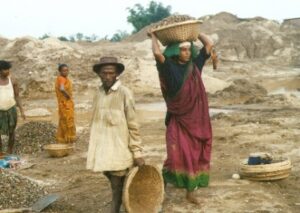
These questions bothered me greatly when the World Bank asked me to write a document outlining a feminist approach to just transition. To make the energy transition gender-just, we cannot think about ‘employment’ in the conventional sense. We must take a long and hard look at the informal economy, where 2 billion people—more than 60 per cent of the world’s employed population — are earning a livelihood. The proportion of ‘contributing family members’ is more than three times higher among women in informal employment compared to men.
I will use some data to explain this slide. As we all know, care is an invisible, underrecorded, underpaid, or unpaid part of the economy. Globally, women do three times as much unpaid care and domestic work as men.
The countries in sub-Saharan Africa rely on over 900,000 community health workers to support their fragile health systems: Over two-thirds of them are women; 86 per cent are unpaid. This must change. For too many years, we have spoken about gender equality, passed laws and helped women’s groups without achieving radical, fundamental and transformative change.
As the advisor to UN Women when it was developing its path-breaking ‘Feminist plan for sustainability and social justice’ document, I insisted that we bring together questions of environmental crises, energy transition, and social and gender justice issues with women’s contributions to livelihoods and the care economy. Cultural transformation can alter power relations between genders, enabling marginalised groups—particularly women and gender minorities. Policies, laws, and institutional practices that challenge gender inequality will follow when women get a voice. Overall, transformative change in gender will create a just and equitable society where all individuals can thrive, free from discrimination and violence, and where gender equality is embedded in the social fabric.
Timothy Mitchell’s book ‘Carbon democracy’ showed how unforeseen kinds of mass politics came into existence with the advent of coal during the 18th century—a whole new world of places like mining towns, new mining communities, new politics like labour unions and political classes where ordinary people forged political consciousness to fight for more egalitarian and democratic collective lives. Today, the Anthropocene has brought us at a similar crossroads in human history. It is for us to choose what kind of world we want to live in, not just a new socio-technical world but a world where our granddaughters can aim to fly high and exert their full agency, not be the recipients of burdens of injustices. Unless we imagine such a world, we will not be able to achieve it.
In today’s talk, I drew upon my work as a feminist researcher in rural areas of the majority world, where I learned from women toiling in agriculture as unpaid family labour, in the informal extractive economies as precarious labourers, managing water at home, and coping with floods on an everyday basis. I stand here today representing each of them. Every woman has a story to tell if there is someone to listen. Each is an extraordinary person, a survivor, a leader, and an innovative thinker.
I hope I have been able to convince you that gendered livelihoods, care, and social justice are the three keys to a possible, gender-equal future world at this critical moment in the planet’s history.
Before I end, I wanted to say a few things about me standing here today, talking to you. As a woman, my life has been defined by many contradictory processes: giving up and dogged determination, letting go and sticking to it, and continuous learning. I am deeply honoured by, and grateful for, this invitation to speak here today. But I would rather stay grounded in my ordinariness, for I know in my heart that I am only one among many, many women who are making small changes in their everyday lives. All these changes are cumulatively leading to that quantitative leap toward a better world.