Introduction
The mining sector has traditionally been conceptualised as a masculine domain, with women’s roles either rendered invisible or marginalised within both industry practices and scholarly analysis. My research has challenged this gendered erasure, revealing women’s multifaceted engagement with mining activities across both large-scale industrial operations and small-scale artisanal sites. My research, spanning over three decades and focusing primarily on South and Southeast Asia, has demonstrated that mining cannot be adequately understood without attending to its gendered dimensions—from labour organisation and resource access to community impacts and resistance movements. In this note, I examine the key themes emerging from my past research publications, highlighting the contributions to understanding gender dynamics in mining contexts, as I look forward to breaking new ground.
Challenging the Masculine Mining Paradigm
I fundamentally contest the notion that mining is inherently or naturally men’s work. I argue that ‘the exclusion of women from mining is not natural or inevitable but is produced through specific historical, cultural, and institutional processes’ (Lahiri-Dutt, 2012a, p. 194). This observation draws attention to the social construction of mining as a masculine space, revealing how ideologies about appropriate gender roles shape industry practices, regulatory frameworks, and community responses to mining activities.
The masculinisation of mining reflects broader patriarchal structures that associate physical strength, technical expertise, and economic provisioning with men while confining women to reproductive and domestic spheres (Lahiri-Dutt, 2013, p. 7). However, these ideological boundaries rarely correspond to actual labour practices, particularly in contexts where economic necessity compels women’s participation in mining work. Her research reveals a persistent gap between gendered ideologies that exclude women and the material realities that require their labour.
In a theoretical contribution to Geography Compass, I (2011, p. 1) provide a comprehensive framework for understanding ‘gendered geographies of mining’, arguing that spatial analysis must attend to how mining creates and transforms gendered spaces at multiple scales—from mine sites and mining camps to households and regional economies. I demonstrate that gender operates not merely as individual identity but as ‘a fundamental organising principle of mining economies and societies’ (Lahiri-Dutt and Macintyre, 2006, p. 2). This analytical shift moves beyond simply documenting women’s presence in mining to examining how gendered power relations structure resource access, labour conditions, remuneration patterns, and community impacts.
Women in Small-Scale and Artisanal Mining
My research on small-scale and artisanal mining reveals women’s extensive, though often unrecognised, participation in these activities. I note that ‘women constitute a significant proportion of the workforce in small-scale mining across Asia, Africa, and Latin America, yet their contributions remain largely invisible in official statistics and policy frameworks’ (Lahiri-Dutt, 2008, p. 206). This invisibility stems partly from the informal, seasonal, and household-based nature of much artisanal mining, which conventional labour surveys fail to capture adequately.
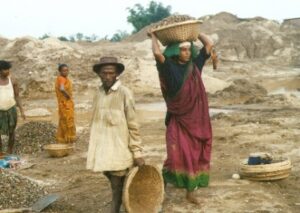
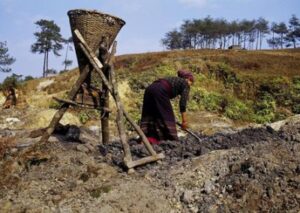
In my detailed ethnographic studies, I examine how women in India’s coal belt negotiate ‘precarious masculinities and femininities’ within mining economies characterised by informality and illegality. I document how women engage in multiple mining-related activities, including extraction, processing, transportation, and trading of minerals. These activities typically receive lower remuneration than men’s work, reflecting gendered wage hierarchies that devalue women’s labour. Women miners often work in family groups or all-female teams, performing tasks deemed suitable for female workers—such as sorting, cleaning, and carrying materials—while men dominate activities requiring mechanical equipment or underground work (Lahiri-Dutt, 2007, p. 456).
Writing in Gender, Place and Culture, I have (2012a, p. 205) challenged the simplistic narratives that portray women in artisanal mining solely as victims of exploitation or poverty. I argues that ‘for many poor rural women, particularly those heading households or belonging to marginalised communities, mining work provides crucial income and autonomy unavailable through other livelihood options’. Women miners exercise agency in navigating constrained circumstances, developing skills, networks, and strategies that enable survival and occasional prosperity within harsh mining environments.
The shift from artisanal to mechanised mining frequently eliminates women’s participation. I suggest that ‘modernisation and formalisation of small-scale mining typically involves masculinisation, as mechanisation privileges male workers while regulatory frameworks exclude informal operators among whom women predominate’ (Lahiri-Dutt, 2006, p. 203). This pattern reflects how development interventions and regulatory reforms, though ostensibly gender-neutral, systematically disadvantage women by failing to recognise or accommodate their specific forms of mining engagement.
In a more recent contribution to The Extractive Industries and Society, I (2019, p. 746) explore the concept of ‘gendered class’ in artisanal mining contexts, demonstrating how gender and class intersect to produce distinct experiences of mining work. I show that poor women miners face ‘triple marginalisation—as workers in informal economies, as women in masculine industries, and as members of subordinated castes or ethnic groups’ (Lahiri-Dutt, 2019, p. 751).
Legal Frameworks and Rights
My work also addresses the legal dimensions of women’s participation in mining. In her analysis published in the Canadian Journal of Women and the Law (Lahiri-Dutt, 2018, p. 410) and in The Extractive Industries and Society (Lahiri-Dutt, 2013, p. 63), I examine how legal frameworks governing mining systematically exclude women through both explicit prohibitions and implicit biases. I trace how ‘protective legislation’ that ostensibly safeguards women’s health actually operates to exclude them from underground mining work and higher-paying positions, reinforcing occupational segregation while failing to address genuine workplace hazards affecting all miners.
I have argued that legal reforms must move beyond simplistic protection paradigms toward frameworks that recognise women’s agency and rights as workers. This includes ensuring equal access to mining licenses, providing occupational health and safety protections appropriate to women’s needs, and guaranteeing equal remuneration for equal work (Lahiri-Dutt, 2013, p. 78). Legal recognition of women’s mining work remains particularly critical in artisanal sectors where informality often means complete absence of labour protections or social security benefits.
Gender Impacts of Large-Scale Mining
My analysis of large-scale industrial mining reveals profound gendered impacts extending beyond direct employment to encompass land displacement, environmental degradation, and community transformation. I argue that ‘the adverse impacts of large mining projects fall disproportionately on women, who typically lack formal land titles, face restricted mobility, and bear primary responsibility for household provisioning and care work’ (Lahiri-Dutt and Ahmad, 2007, p. 297).
Land acquisition for mining projects frequently dispossesses women who, despite cultivating land and depending on it for livelihoods, rarely possess formal ownership rights in patriarchal property systems. My observation is that ‘compensation schemes typically recognise only titled landowners, predominantly men, leaving women who worked as agricultural labourers, sharecroppers, or gatherers of common resources without recompense for livelihood losses’ (Lahiri-Dutt, 2012a, p. 196). This gendered pattern of dispossession mirrors broader dynamics of land acquisition in India, where formal property rights determine compensation entitlements regardless of actual dependence relationships.
Environmental degradation from mining operations—including water pollution, deforestation, and air contamination—disproportionately affects women due to their roles in collecting water, gathering fuelwood, and managing household health (Lahiri-Dutt, 2015, p. 229). As environmental quality deteriorates, women must travel farther and expend more labour to secure basic resources, intensifying their work burdens, while men’s wage labour patterns may remain relatively unchanged. In The Extractive Industries and Society, Lahiri-Dutt (2016, p. 567) examines how mining’s environmental impacts thus redistribute labour within households in gendered ways that often escape official impact assessments. Large mining projects promise employment and development benefits, yet I have demonstrated that women rarely access these opportunities. I argue that ‘mining companies overwhelmingly recruit men for operational positions while women, if employed at all, occupy subordinate roles in catering, cleaning, or administrative support’ (Lahiri-Dutt and Robinson, 2008, p. 348). This employment pattern reflects both the company’s recruitment preferences favouring male workers and community resistance to women working in mining, which is perceived as inappropriate or threatening to social respectability.
Embodiment, Sexuality, and Mining Masculinities
In my scholarship on gender and mining, I have paid particular attention to how bodies, sexuality, and gendered identities are produced and contested in mining contexts. In Gender, Place and Culture, I explore how ‘mining work shapes and is shaped by embodied performances of masculinity and femininity that naturalise gender hierarchies while rendering them apparently inevitable’ (Lahiri-Dutt, 2012b, p. 457). Mining masculinities emphasise physical strength, risk-taking, and technical mastery, creating workplace cultures that marginalise women and subordinate men who fail to perform appropriate masculine identities.
My work also examines how menstruation becomes a site of exclusion in mining contexts. Lahiri-Dutt and Robinson (2008, p. 110) document how beliefs that menstruating women bring bad luck or cause mine accidents justify excluding women from underground work and higher-status positions. These ‘period problems’ reflect how bodies become invested with meanings that legitimise discrimination while masking economic interests in maintaining male privilege within mining labour markets.
Women’s Resistance and Agency in Mining Contexts
I have also highlighted women’s active participation in resistance movements against mining projects, challenging the portrayal of mining conflicts as gender-neutral struggles over resources and development. I argue that ‘women often constitute the backbone of anti-mining movements, providing sustained mobilisation, articulating alternative development visions, and confronting both mining companies and state authorities’ (Lahiri-Dutt, 2016, p. 181).
Women’s motivations for resisting mining projects frequently differ from men’s concerns. While men may focus on compensation rates and employment opportunities, women emphasise threats to subsistence economies, community integrity, and environmental health (Lahiri-Dutt and Ahmad, 2007, p. 301). These gendered priorities reflect women’s specific positionality within mining-affected communities and their responsibilities for social reproduction, which mining projects fundamentally disrupt.
In an article published in The Extractive Industries and Society (2017, p. 892), I document how women deploy diverse resistance strategies, ranging from legal challenges and petitions to physical blockades and public protests. In some contexts, women’s resistance proves particularly effective because cultural norms discourage physical confrontation with women, enabling them to maintain blockades that male protesters cannot sustain. However, this tactical advantage should not obscure the genuine risks women face, including violence, arrest, and social stigmatisation for transgressing gender norms through public political activism.
Toward Gender-Just Mining Governance
This body of research offers important implications for mining governance and policy. I have consistently advocated for regulatory frameworks that recognise women’s diverse relationships with mining—as workers, resource users, community members, and environmental managers—rather than treating gender as peripheral to mining’s core concerns (Lahiri-Dutt and Macintyre, 2006, p. 12). This requires moving beyond token inclusion measures toward fundamental restructuring of how mining impacts are assessed, how compensation is distributed, and how alternative livelihoods are supported.
In an invited article in Geography Compass (2011, p. 11), I emphasise the necessity of gender-disaggregated data collection to render women’s mining work visible and valued. Current statistical systems systematically undercount women miners by focusing on formal employment and failing to recognise part-time, seasonal, or household-based mining activities. Better data could inform policies that protect women miners’ rights, improve their working conditions, and ensure their access to benefits from mineral resources.
Summarising
My scholarship fundamentally transforms understanding of gender and mining, revealing women’s extensive yet undervalued participation in mining activities and demonstrating how mining transformations produce distinctly gendered impacts. Her work challenges the persistent ideology that constructs mining as masculine terrain, showing instead how gender operates as a constitutive element of mining economies and societies. By foregrounding women’s experiences as miners, community members, and activists, I illuminate dimensions of mining conflicts and impacts that gender-blind analysis obscures.
Her research demonstrates that achieving gender justice in mining contexts requires more than simply increasing women’s employment in mining companies. Instead, it demands comprehensive attention to how mining affects women’s land rights, environmental resources, labour opportunities, and community wellbeing. It requires recognising and valuing women’s existing mining work, particularly in small-scale and artisanal sectors. And it necessitates ensuring women’s meaningful participation in decisions about mining governance, from initial project approval through impact management and benefit distribution.
As mining continues expanding globally, driven by demand for minerals essential to energy transitions and technological development, my research provides crucial frameworks for understanding and addressing mining’s gendered dimensions. Her scholarship insists that equitable and sustainable mining governance cannot be achieved without centrally addressing gender relations and ensuring that women’s voices, knowledge, and priorities shape mining futures.
References
Lahiri-Dutt, K. (2006) ‘Gendered livelihoods in small mines and quarries in India: Living on the edge’, in Lahiri-Dutt, K. and Macintyre, M. (eds.) Women miners in developing countries: Pit women and others. Aldershot: Ashgate, pp. 199-221.
Lahiri-Dutt, K. (2007) ‘Roles and status of women in extractive industries in India: Making a place for a gender-sensitive mining development’, Social Change, 37(4), pp. 37-64.
Lahiri-Dutt, K. (2008) ‘Digging to survive: Women’s livelihoods in South Asia’s small mines and quarries’, South Asian Survey, 15(2), pp. 217-244.
Lahiri-Dutt, K. (2011) ‘Gendering the field: Towards sustainable livelihoods for mining communities’, Geography Compass, 5(6), pp. 1-19.
Lahiri-Dutt, K. (2012a) ‘Digging women: Towards a new agenda for feminist critiques of mining’, Gender, Place and Culture, 19(2), pp. 193-212.
Lahiri-Dutt, K. (2012b) ‘The shifting gender of coal: Feminist musings on women’s work in Indian collieries’, Gender, Place and Culture, 19(4), pp. 456-476.
Lahiri-Dutt, K. (2013) ‘Bodies in/out of place: Hegemonic masculinity and kamins’ motherhood in Indian coal mines’, South Asian History and Culture, 4(2), pp. 213-229.
Lahiri-Dutt, K. (2013) ‘Gender (plays) in discussing mining and gender in Canada and beyond’, Canadian Journal of Women and the Law, 25(1), pp. 63-82.
Lahiri-Dutt, K. (2015) ‘The diverse worlds of coal in India: Energising the nation, energising livelihoods’, Energy Policy, 99, pp. 203-213.
Lahiri-Dutt, K. (2016) ‘Extractive peasants: reframing informal artisanal mining debates’, Third World Quarterly, 37(2), pp. 560-582.
Lahiri-Dutt, K. (2017) ‘Reframing the perception of informal mining’, The Extractive Industries and Society, 4(4), pp. 889-891.
Lahiri-Dutt, K. (2018) ‘Between legitimacy and illegality: Informal coal mining at the limits of justice’, in Lahiri-Dutt, K. (ed.) Between the plough and the pick: Informal, artisanal and small-scale mining in the contemporary world. Canberra: ANU Press, pp. 403-424.
Lahiri-Dutt, K. (2019) ‘Gendered livelihoods in small mines and quarries in India: Analysing class dynamics’, The Extractive Industries and Society, 6(3), pp. 745-753.
Lahiri-Dutt, K. and Ahmad, N. (2007) ‘Considering gender in social impact assessments’, in Vanclay, F. and Becker, H.A. (eds.) The international handbook of social impact assessment. Cheltenham: Edward Elgar, pp. 117-137.
Lahiri-Dutt, K. and Macintyre, M. (eds.) (2006) Women miners in developing countries: Pit women and others. Aldershot: Ashgate.
Lahiri-Dutt, K. and Robinson, K. (2008) ‘”Period problems” at the coalface’, Feminist Review, 89(1), pp. 102-121.